

Residential Milling & Urban Wood Services in the San Francisco Bay Area
On-site tree milling and custom urban wood creations for Bay Area homes.
What Is Residential Milling & Urban Wood?
Urban wood is lumber milled from trees that came down in a city — removed for safety, disease, construction, or age — rather than harvested from a forest. It is the same species you would pay a premium for at a hardwood dealer, except it grew two miles away and would otherwise have been chipped.
Arborist Now mills it and sells it. You can have a tree from your own property milled into slabs, buy from the lumber already in our San Francisco yard, or commission a finished piece. You do not need to be a tree care customer to buy wood from us — most people who do are not.
Bay Area trees produce material that is hard to find commercially. Coast live oak, blackwood acacia, and eucalyptus rarely reach lumber yards at any size, and a single mature specimen can yield slabs wide enough for a dining table cut from one board. That is the transformation worth paying for.

Three Ways Homeowners Work With Us
Mill Your Own Tree
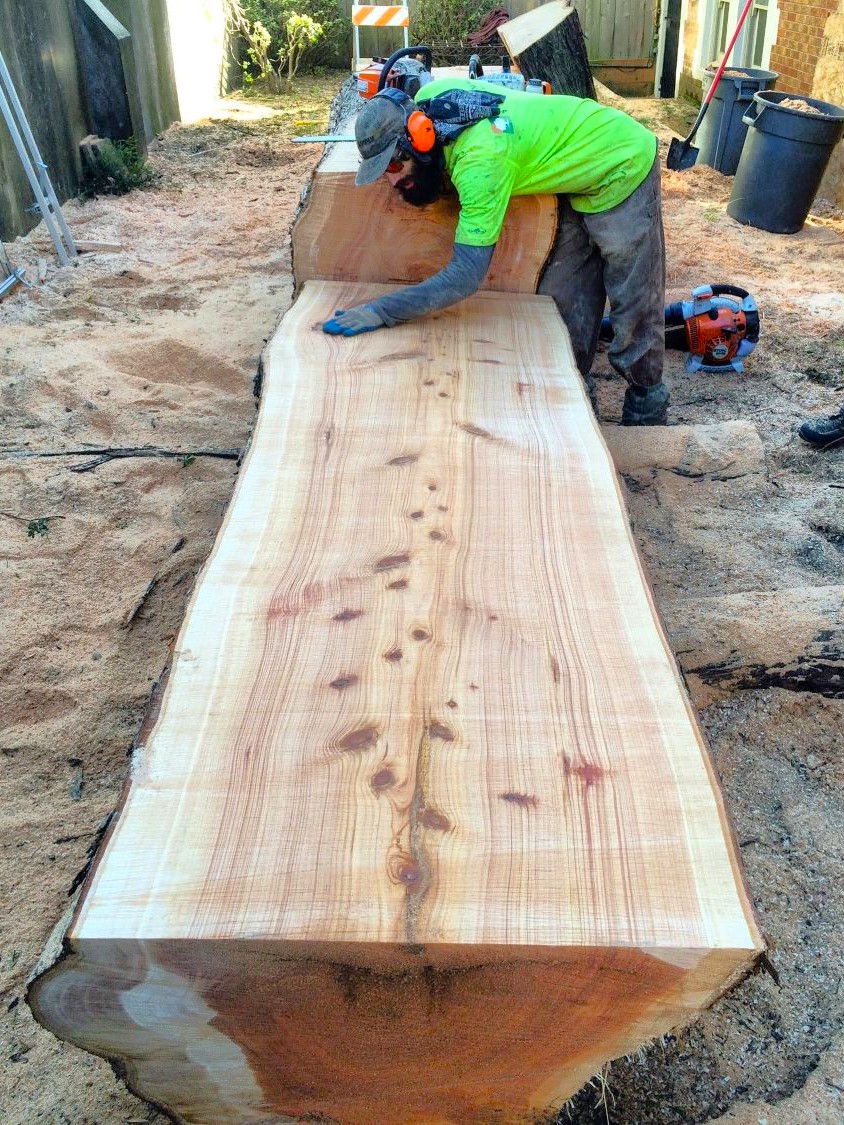
If a tree is being removed from your property, the wood does not have to leave as chips. Arborist Now can mill it on site with a portable mill or haul the logs to our yard and cut them to your specifications. Say so before the removal is scheduled — how a tree is felled determines what can be cut from it, and a trunk sectioned for disposal cannot be uncut.
Choose From Our Urban Wood Inventory
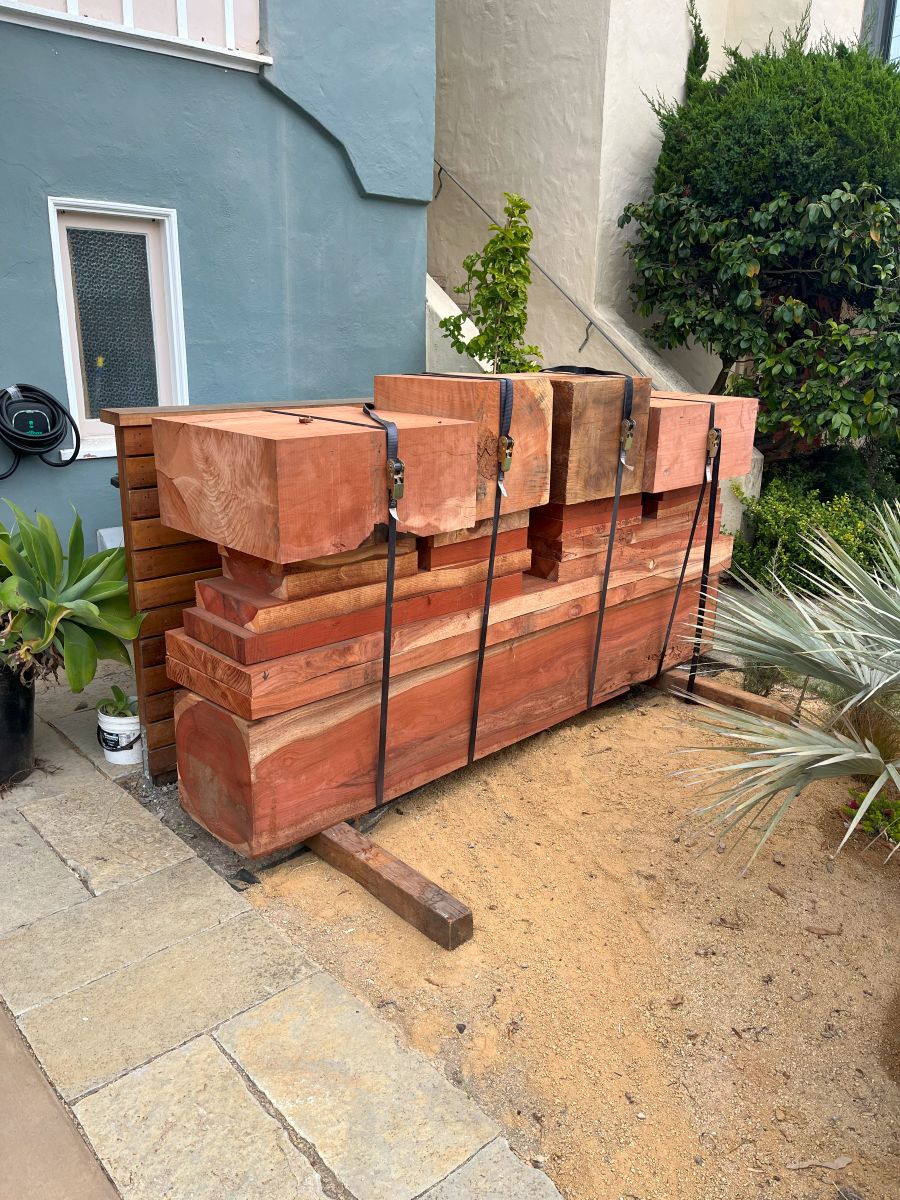
Our San Francisco yard holds slabs and lumber milled from Bay Area trees, drying and ready. Anyone can buy from it — woodworkers, designers, contractors, and homeowners with a project in mind. Come see what is there; slabs are individual, and photographs don’t do them justice.
Commission a Custom Residential Piece
Bring us a use and a space, and we will build to it — a dining table, a bench, a mantel, a countertop. Arborist Now handles milling, drying, fabrication, and finishing, and can install the piece if needed. Commissioned work starts with the slab, so the piece is designed around the wood rather than the wood being forced into a plan.
Live edge slabs and custom tables
A live edge slab keeps the natural outline of the tree along one or both sides instead of being squared off. It is the reason a single board can become a dining table that nothing else in the room matches, and it only works if the log was milled with that in mind.
Arborist Now cuts live edge slabs from Bay Area trees and keeps finished and drying stock at our San Francisco yard. Widths depend on the tree — coast live oak and blackwood acacia commonly yield slabs wide enough for a table top from a single board, which is uncommon in commercially available hardwood.
Slabs can be bought raw for your own fabrication, surfaced and flattened ready to work, or built into a finished piece by our shop. If you are looking for live edge wood slabs near you rather than ordering something shipped from across the country, the wood in our yard grew here.
On-Site & Yard Milling Capabilities
Arborist Now runs a portable mill that comes to the property and a yard operation in San Francisco for logs that are easier moved than cut in place. Which one makes sense depends on access, log size, and how much material is coming off the tree.
On-site milling suits properties with room to work and logs too large to move economically. Yard milling suits tight urban lots, jobs that need more control over the cut, and anything that will be drying with us afterward. We will tell you which applies when we see the tree — or the logs, if they are already down.

Custom Residential Creations
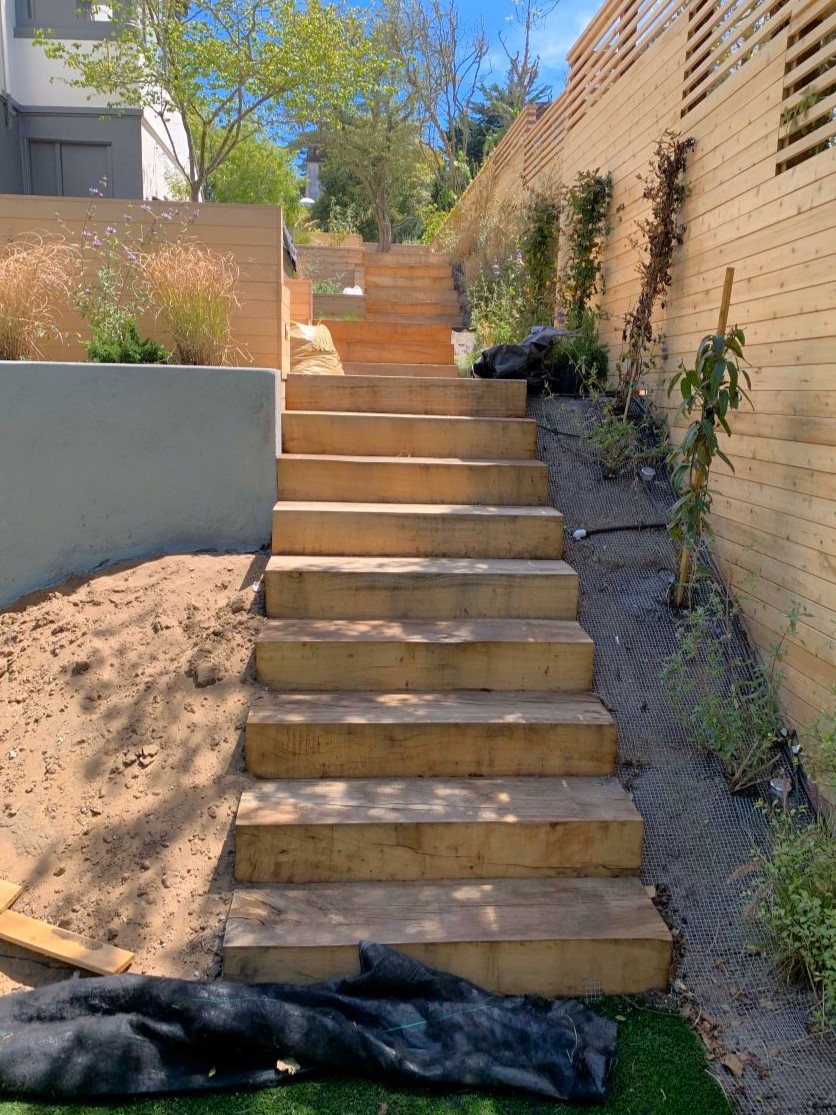
- Custom benches and seating
- Dining and outdoor tables
- Live-edge slabs
- Garden and landscape features
- Sculptural and artistic elements
- Architectural wood accents
Local Urban Wood Inventory
Oak, Elm, Eucalyptus, Redwood, Giant Sequoia, Blackwood Acacia, and more.

How long does milled wood need to dry?
Longer than most people expect, and it is the single thing that surprises homeowners who have just had a tree taken down. Arborist Now air dries, which runs roughly a year per inch of thickness. A three-inch slab destined for a dining table is a multi-year proposition from the day the tree comes down. There is no shortcut worth taking — wood dried too fast checks and splits.
Wood that has not dried enough will move after it is built — cupping, twisting, and splitting at the joints — and no amount of finishing prevents it. This is why Arborist Now keeps drying inventory: buying a slab that came down two years ago means the waiting is already done.
If you are milling your own tree and want the finished piece sooner, tell us at the outset. Slab thickness and species both change the timeline, and there are decisions worth making before the first cut rather than after. If the wait does not work for your project, buying from the drying stock already in our yard usually does.
What does custom milling cost?
Milling and finished pieces are quoted per project. What drives the number:
- On-site or yard. Bringing the portable mill to a property is priced differently from cutting logs already at our yard.
- Log size and species. Larger logs and harder species take longer and wear more blade.
- Metal in the wood. Urban trees swallow nails, fence wire, and old hardware. Hitting it destroys a blade and it is not always detectable beforehand.
- Slab count and thickness. How the log is broken down determines both yield and cost.
- Storage while drying. Slabs air drying in our yard occupy space for years, and that is factored in.
- Finish level. Raw slab, surfaced and flattened, or a finished and installed piece are three different jobs.
Tell Arborist Now what the wood is for and we will quote the scope before anything is cut. If milling your particular tree is not worth what it would cost — which happens, and rot or embedded metal is usually why — we will say so.
A Sustainable Second Life for Urban Trees
Urban wood is a byproduct of necessary tree removals. Instead of sending this valuable material to landfills, we give trees a meaningful second life.
The Residential Urban Wood Process
- Tree assessment or project consultation
- Log selection or salvage
- Custom milling
- Drying and finishing
- Design and fabrication
- Optional installation

Why Arborist Now for milling and urban wood?
Commercial Tree Care Across the Bay Area
Arborist Now delivers commercial tree care services throughout San Francisco and the surrounding Bay Area. Our team understands the operational, safety, and regulatory considerations involved in managing trees on shared-use and public-facing properties, providing reliable service aligned with urban and commercial needs.
Commercial tree care FAQs
Are you licensed and insured?
Yes. Arborist Now holds CA License 961415, carries commercial insurance, and is CTSP #03302 certified. Certificates of insurance are provided on request and can name additional insureds where a contract requires it.
Do you work with HOAs and property management companies?
Yes. HOAs, property managers, municipalities, and corporate campuses make up a large share of Arborist Now’s commercial work. We are used to reporting into boards and providing the documentation that decisions get recorded against.
Can you work outside business hours?
Yes. Arborist Now schedules commercial work early mornings, weekends, and outside operating hours where a site cannot absorb disruption during the day. That is arranged at the assessment rather than negotiated on the morning.
Do you provide documentation after the work?
Yes. Every commercial job includes a written scope beforehand and confirmation of what was completed afterward — the record a property manager needs for the file or an HOA board needs for the minutes.
Who is responsible for permits on commercial tree work?
Permits are the property owner’s responsibility to obtain. Arborist Now identifies during the assessment whether a tree falls into a regulated category in San Francisco and can prepare the arborist documentation an application requires.
Do you offer 24-hour emergency service?
No. Arborist Now schedules storm response when conditions allow but does not operate a 24-hour emergency line. Where a tree failure has created an immediate danger to people or a structure, call emergency services first.
Can you manage tree care across multiple properties?
Yes. Arborist Now works across portfolios as well as single sites. For clients with a large tree inventory we usually recommend prioritizing work by risk across the portfolio rather than treating each property in isolation.
How do you handle traffic and pedestrian safety during the work?
Work on public-facing sites is planned around access before it is scheduled — flagging, lane closure, or pedestrian rerouting where the job touches a roadway or walkway. Arborist Now’s crews are trained for occupied and regulated environments, which is what CTSP certification covers.
Can I buy wood if I am not a tree service customer?
Yes. Anyone can buy from Arborist Now’s urban wood inventory — woodworkers, designers, contractors, and homeowners. Most people buying slabs from our San Francisco yard have no tree being removed and no prior relationship with us.
What is a live edge slab?
A live edge slab keeps the natural outline of the tree along one or both edges rather than being squared off. It has to be milled with that intent from the start. Arborist Now cuts live edge slabs from Bay Area trees and stocks them at our San Francisco yard in raw, surfaced, and finished form.
What species do you carry?
Arborist Now’s inventory varies with what comes down, but commonly includes coast live oak, elm, eucalyptus, redwood, giant sequoia, and blackwood acacia. Several of these rarely reach commercial lumber yards at usable width, which is part of why urban wood is worth milling.
Do you mill logs I already have?
Yes. Arborist Now mills customer-supplied logs at our San Francisco yard or on site. Be aware that urban logs often contain nails, fence wire, or old hardware that is not visible from outside and can destroy a blade — we will assess before cutting.
How wide can a slab be?
It depends entirely on the tree. Mature coast live oak and blackwood acacia in the Bay Area commonly yield slabs wide enough for a dining table cut from a single board, which is uncommon in commercially available hardwood. Arborist Now can tell you what a specific log will yield before it is cut.
Residential Milling & Urban Wood FAQs
Can you mill wood from a tree being removed from my property?
Yes. Arborist Now can mill your tree on site with a portable mill or haul the logs to our San Francisco yard. Tell us before the removal is scheduled — how a tree is felled determines what can be cut from it, and a trunk already sectioned for disposal cannot be recovered.
How long does the wood need to dry before it can be used?
Arborist Now air dries, which takes roughly one year per inch of thickness — so a three-inch slab is a multi-year wait from the day the tree comes down. If that does not suit your timeline, our San Francisco yard holds slabs milled years ago that have already done the waiting.
What types of pieces can be made from urban wood?
Dining and outdoor tables, benches and seating, live edge slabs, mantels and countertops, garden and landscape features, architectural accents, and sculptural work. Arborist Now handles milling, drying, fabrication, finishing, and installation.
Is urban wood suitable for outdoor use?
Some species are. Redwood and blackwood acacia hold up well outdoors; others need protection or are better kept inside. Arborist Now matches the species to where the piece is going rather than treating all urban wood as interchangeable.
Do you offer installation services?
Yes. Arborist Now can install finished pieces where installation is needed, including built-in and architectural work.